

Angels Among Us
Teen years in 1980s' "Lynn, Lynn, City of Sin"

It wasn’t until my younger brother Scott hit his teens that we were able to have the same friends. The teen years brought similar interests and activities, which in 1980s Lynn, Massachusetts, were not many, and the younger kids that he played with as children merged with those with whom I’d played. That was also about the time that Gary came around.
Growing up in Lynn, it was always good to know what neighborhoods to circumvent, as well as your home bounds—where you could walk freely and know that you were surrounded by friends and friendly families behind most every door. Our safe zone, I guess what another generation might call our turf, was essentially a three-block area sandwiched between Union, Essex and Chestnut Streets, three of East Lynn’s primary roads. To the kids who grew up there—Scott and I, the Parsons boys, the Coughlin girls, the McNairs, the Winchells, the Ameros and about a dozen other kids older and younger—the network of alleys, holes in fences, and backyards connecting Lincoln Street, Shaw’s Court, Union Place and Union Court were our thoroughfares, known and used only by us. The half dozen or so vacant lots that dotted the neighborhood—for Lynn at the time had the worst arson problem in the state—were our playgrounds and ballfields, strewn with weeds, rocks and broken glass. But always, it felt safe, even after dark. Our few blocks of inner city were anchored by a Hell’s Angels’ clubhouse. Some of them lived among us. We knew some of them by name, and they knew us. If we hit a ball over the stockade fence surrounding the clubhouse yard, they’d toss it back, or if they weren’t there at the time, they’d later wedge it on top of the fence pickets where we could retrieve it without having to face the pit bulls they kept there. Otherwise, they left us alone, and aside from the sometimes around-the-clock chopper noise, they were good neighbors. Best of all, the Angels’ clubhouse was well-known, and few outsiders dared cause trouble in our little patch of rotting urbania.
Gary Sapier was a familiar face to us, though no one really knew him personally. His neighborhood was immediately across Essex Street from us, another maze of side streets and dead-ends where Sheridan Street sloped suddenly upward into East Lynn’s hilly hood called “The Highlands.” Gary’s home territory was of the same general population as ours: several borderline-poverty families with children of all ages, including a core of some dozen or so teenagers bordering on delinquency. Gary had grown up around Sheridan Street and Ashton Terrace with the Jacksons, the Hitajs, the Conroys and the Haskells.
There were no rivalries or inner-city turf wars between the two neighborhoods. None of that gang shit that terrorizes so many other inner cities. Parents on both sides of the street had known each other for years or decades, and we shared the same convenience stores and sub shops. We kids knew each other casually from school, whether at my Lynn English High or at “Tech” (Lynn Vocational Technical School)—the trade school attended by Scott and numerous other kids from our neighborhoods.
Gary’s family moved to our side of Essex Street right around the time the teens of both neighborhoods were coming to the age where life’s direction, or serious trouble, began. The Sapiers took a place in the sprawling gray apartment building on the corner of Lincoln and Union Streets. At first we’d see Gary passing up and down Lincoln Street, apparently on a daily migration between his home turf and his family’s apartment. It was no more than a five-minute stroll, so small were our neighborhoods.
Gary was Mi’kMaq, one of Canada’s First Nations tribes, though at the time I had no idea how much that influenced his life. He topped 5-foot-7 on his tiptoes. Even with the leather jacket he sported in winter, he might have sniffed 150 pounds. But his forearms were laced with steel cables and he strode confidently, without swagger, his leather jacket or a demin counterpart slung over one shoulder. Both sides of Essex Street had their share of juvenile delinquents, but the Sheridan Street kids were, in my eyes, the tougher breed. Gary was one of them. He was simply unafraid of anyone, and despite his size, he was well-respected even by the toughest of his peers.
The first time I spent any meaningful time in Gary’s proximity, I got a glimpse why. He had been hanging around our crew for a few days, slowly and cautiously getting to know a few of us, though not yet me. A group of us were hanging out one afternoon in the Coughlins’ backyard; he and I had exchanged just a few sentences. I was a perpetual wisecracker, always busting someone’s balls with one-liners. “Capping,” we called the act of putting down another. I slung a cap at Gary. I don’t recall what I said, and I meant no harm. But within a second he was in my face. Or at least five inches below it. I outweighed him by 50 pounds easily. And still he stared me down. Completely unnerved me. I swear his pupils dilated until his eyes were like those of a shark: black, white and dead.
“You’re not going to hurt anyone with those chubby little fists.”
That’s all he said to me. He wasn’t just capping back, he was calling me out then and there.
I forget exactly what I said in response. I know I said it without fear or supplication, but more importantly without antagonism or defiance. It was something calm and casual—or at least as best as I could manage, because I was intimidated—something like, “I’ve got no reason to fight you, so what’s the difference?” Wimpy, yes, but neither offensive nor defeated.
Whatever I said, for whatever reason, it disarmed him. And within a week, we found ourselves sitting on my front porch playing chess.
Growing up in the poorer, seedier parts of Lynn gives you street smarts and a certain toughness you’ll carry all your life. But I was not, by Lynn standards, a tough kid. There weren’t a lot of people afraid of me, at least not among the truly tough guys. I was one of the nerdy, brainy kids, tainted though I was by the street like the rest. Gary was one of the Sheridan Street kids. Reputed punks. Which is why it amazed me when on the chessboard, he kicked my ass, again and again.
I had played chess throughout my childhood, but never with any direction or competition other than other kids who, like me, knew the moves and nothing more. Gary, however, knew fundamentals of chess strategy—control the center of the board, develop your pieces, protect the king. We talked as we played, and discovered similar interests in music and sports, and also in family backgrounds. Too many kids in our hood were products of broken homes. Like us. Gary was raised by his mother, and he would say nothing of a father. Unlike Scott and I, Gary had several siblings, including two older sisters, one who lived in the area and one in Prince Edward Island, Canada, where his family originated. Also living with him and his mother at the corner of Lincoln Street were his younger sister, Angela, and Jimmy, his older brother. Jimmy was BIG. A simply massive young man. He was the anti-Gary. He towered over me, in both height and breadth. Yet the brotherly resemblance was remarkable. A few years earlier, Jimmy was a star offensive lineman at Lynn English. Not just a high-school, “read-about-him-in-the-hometown-paper” star, but one of those once-in-a-city’s-lifetime stars headed for major college football and beyond. Until a tragic car accident left him blind before he ever played a college down.
When it came to street toughness, the difference between Gary and I is defined by the story of the Ridder brothers. Alex and Johnny Ridder (not their real names) lived in the house behind mine. Our backyards were separated by a five-foot, open-picket fence. The Ridders were not members of our neighborhood from childhood. They moved in around the same time Gary started coming around, and they seldom hung with our group. Fortunately, I was cool with them, for even by the toughest of Lynn standards, the Ridders were bad-asses. If memory serves, Alex was my age and Johnny two years younger (and Gary was 11 months younger than me, to the day, putting him squarely between the two of them). Both Ridders were considerably taller and more chiseled than me. I don’t remember which incident happened first, but both occurred when I was 16.
Alex and Gary were friends from somewhere in their pasts, but at some point a year or so after he moved to Lincoln Street, they had a falling out. Gary wouldn’t say why, but word was out in the hood that Alex “was looking for” Gary—an open warning that they would fight on sight. So one afternoon Gary announced he was going to seek out Alex and get it over with. As tough as Gary was, we all knew it was a mismatch.
Gary was gone a few hours, and according to eyewitness accounts (embellished or not), Alex dropped Gary with a flurry of punches, then landed several head and body kicks before leaving Gary laid out on the street. In the evening, Gary finally reappeared, without a mark on him save the smallest of mouses under one eye.
My run-in with the younger but larger Johnny was over one of the neighborhood girls. She was his ex-girlfriend, and when she and I got together, me being a wise-ass out to impress, I slung a few caps at Johnny’s absentee expense. Of course, she and I petered out weeks later, and she found herself back together with him. Which is when he came looking for me.
He caught me one night on my way to pick up a pizza from Georgia’s, a 10-minute walk away on Union Street. (Now gone, Georgia’s to this day remains the best pizza I’ve ever had.) I took a neighborhood shortcut, scaling a stone wall that cornered the Ridder’s property on the Union Court side, farthest from my house. When I crested the wall, I grabbed a Ridder fencepost for support. Alex was on his porch, making out with his girlfriend, and scared the shit out of me when from 10 feet away he bellowed “Get off the fucking fence!” I stumbled over the fence and continued on my way while, whining like Steve Buscemi, I told Alex to take it easy.
Union Court is an L-shaped hill with its peak at the L’s joint, and the Ridders’ house sat at the bottom of the hill on one end. I was just cresting the hill about 400 feet away, making the turn to descend to Union Street, when I heard my name.
Johnny jogged up the hill toward me. To be honest, I had completely forgotten any caps I’d made about him. It had been a couple months ago. I had no idea he was looking for me, or even why Alex had reacted so explosively over me touching a fencepost.
I offered Johnny the standard street greeting of “‘S’up?” then asked what was bugging Alex. Johnny angrily berated me for climbing on the fence. I argued,incredulously. This continued for perhaps 30 seconds until Johnny said, “You want me? I heard you want me.”
No way. Hell, no. I wanted no piece of Johnny Ridder, and didn’t believe I’d ever said so. Not even to her. It didn’t matter. I was going to get him anyway.
Johnny shoved his open left hand toward my face, as if to palm my mug like a basketball. I reacted with a wild left haymaker but his hand arrived an instant before mine and I missed badly. I saw him counterpunch, a right hook. I remember an instantaneous thought that he had big knuckles as they appeared before my face. Then I saw stars. Next I knew, I was sitting on the ground, swinging wildly at the air. Johnny had knocked me out, and now he danced like a boxer above me, fists raised, calling for me to get up. Why he didn’t kick me while I was down, I don’t know. It was a cruel truth of street fights: you get the other guy down, you kick him until he’s staying down.
So I got up. And ran down the hill.
Johnny gave chase. The slope of Union Court ended abruptly at Union Street, whose two lanes were always busy. I hit the bottom of the hill and bolted across—traffic be damned—right into Mike Conroy, standing on the opposite corner.
Mike was one of my friends from Sheridan Street, a year older than me. We used to walk to English High in the same group, a posse that grew each time it passed another kid’s house. He also was very tight with my Mom, knowing her from the neighborhood convenience store where she worked and from the few times he’d come by the house with me. She liked him, she sensed an innate decency in him despite his hardness, something lacking in most of the potential and current delinquents we knew. But there was nothing soft about Mike Conroy. He was one of the very few people who could cow Johnny Ridder.
My left eye was already swelling shut as I panted, adrenaline-charged, in front of Mike. The entire episode was mere seconds. He saw my eye and saw Johnny reach the bottom of the hill across the street. Mike took a step off the curb toward him. Johnny turned and trotted back up the hill. Mike let him go. The message was sent. By the rules of the street, Johnny and I had unfinished business because I’d ran rather than stand and fight, but he never bothered me again.
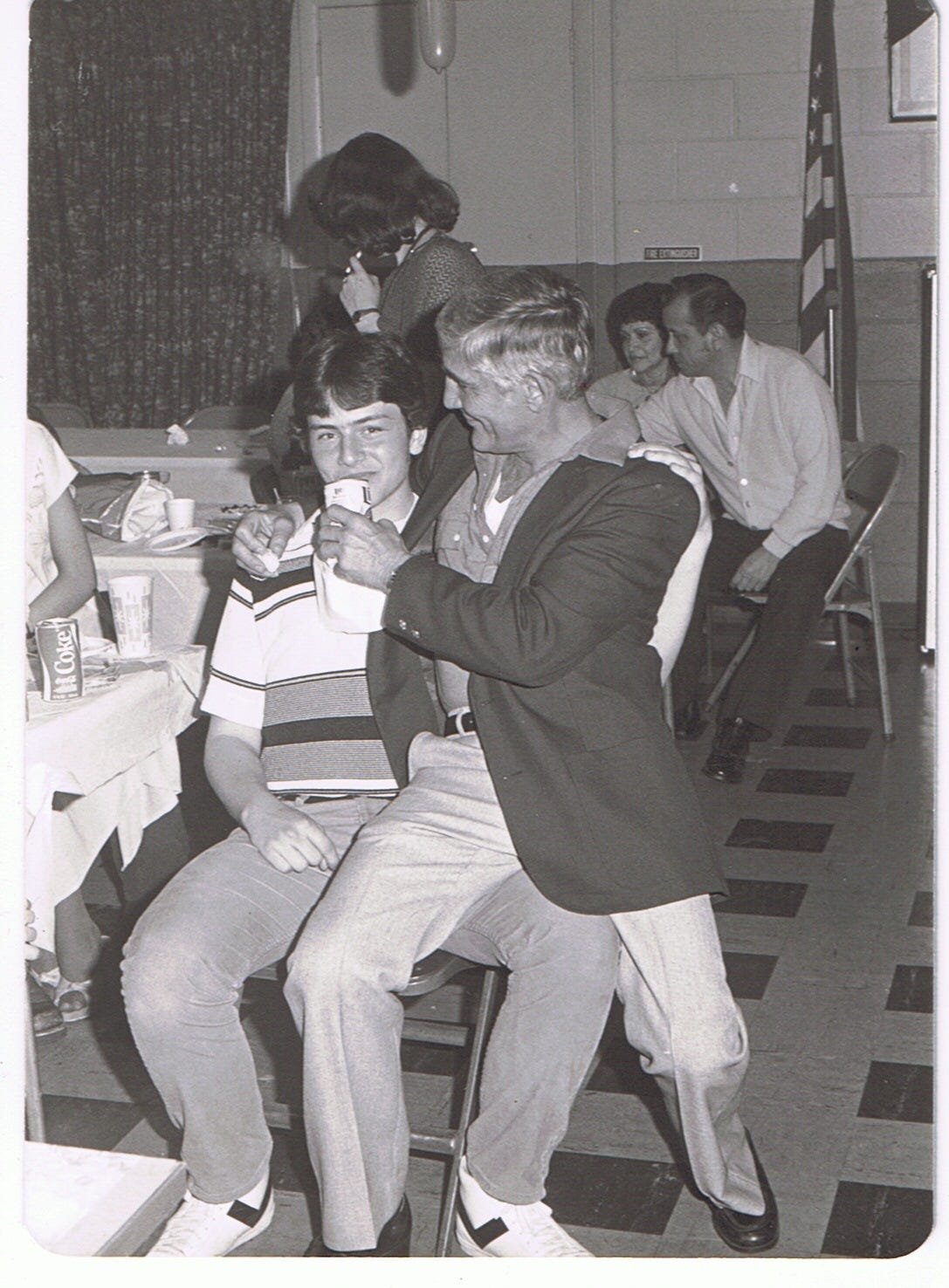
Several days later, I attended a family reunion. I think it was my grandmother’s 70th birthday. My eye was still a purple welt, and I have a black-and-white picture of me and sitting my lap, my Uncle Al, a former pro boxer. I still treasure that photo. Something poetically ironic about my tough-as-nails Italian boxer uncle sitting on my lap, my own eye almost swollen shut.
Mike disappeared a few years after he saved me from Johnny Ridder. There was a fight and Mike put the guy in the hospital. It turned out, the kid was a cop’s son. Mike was in big trouble. Word on the street was cops in every North Shore city were looking for him. God help the kid if they caught him. He was no more than 20 at the time. And suddenly he was gone. Rumor on the street was maybe a couple Angels who knew him may have helped him get out of the state. For 20-plus years, I wondered how he was doing. Then about 20 years ago, after I’d settled in Colorado, my mom told me she ran into him in Lynn. Mom said he’d moved to New Hampshire and was leading a good life, married with kids. I was happy to hear that angels, apparently, had kept him safe.
I wrote the first version of this piece about 20 years ago, soon after my mom told me he was doing well. I was editing it last week to post it on Substack, and had even changed Mike’s name to respect his privacy. I still didn’t know what’d become of him since my mom’s update. No one I knew had seen him again, and I never found him on social media. I searched for him again while editing this. It saddened me greatly. He died Aug. 10, 2025, surrounded by loved ones including his children and grandchildren. The online tributes revealed a man deeply loved, and who loved deeply, now living among the angels. I wish I had looked for him sooner, so I could have told him I’d come to see him as an angel too.
Our maze was a safe zone, emotionally and with body. Well captured, well said!!